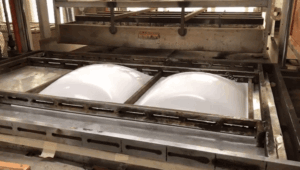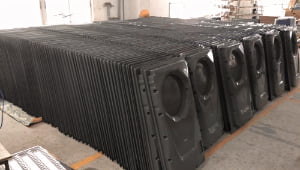
Your vacuum forming project could fail before it even begins. Poor design choices lead to webbing, cracking, and costly remakes1 that devastate budgets.
Successful vacuum forming requires understanding material flow2, draw ratios3, and tool design fundamentals4. Critical factors include proper draft angles5, texture considerations, and strategic venting to ensure quality parts that release cleanly from molds.
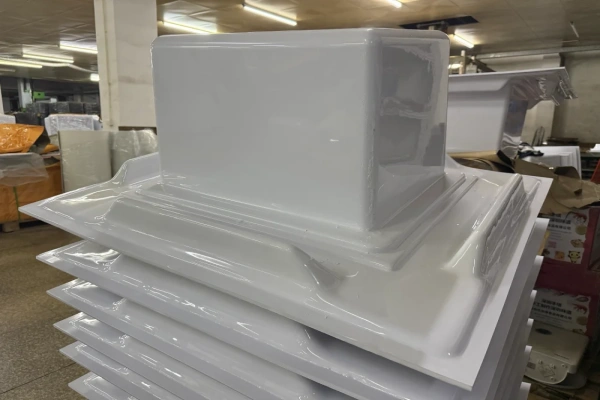
Whether you're developing product prototypes or planning mass production, vacuum forming offers incredible versatility at competitive costs. However, the difference between success and failure often lies in understanding design principles that work harmoniously with the thermoforming process.
What is the Vacuum Forming Process and Why Does It Matter?
Understanding the vacuum forming process prevents costly design mistakes. Many designers lack deep knowledge of basic principles, creating unnecessary complications and expenses.
Vacuum forming heats plastic sheets to predetermined temperatures, then applies vacuum below the mold. Atmospheric pressure forces the heated plastic to adopt the mold shape, creating structurally sound parts with smooth finishes.
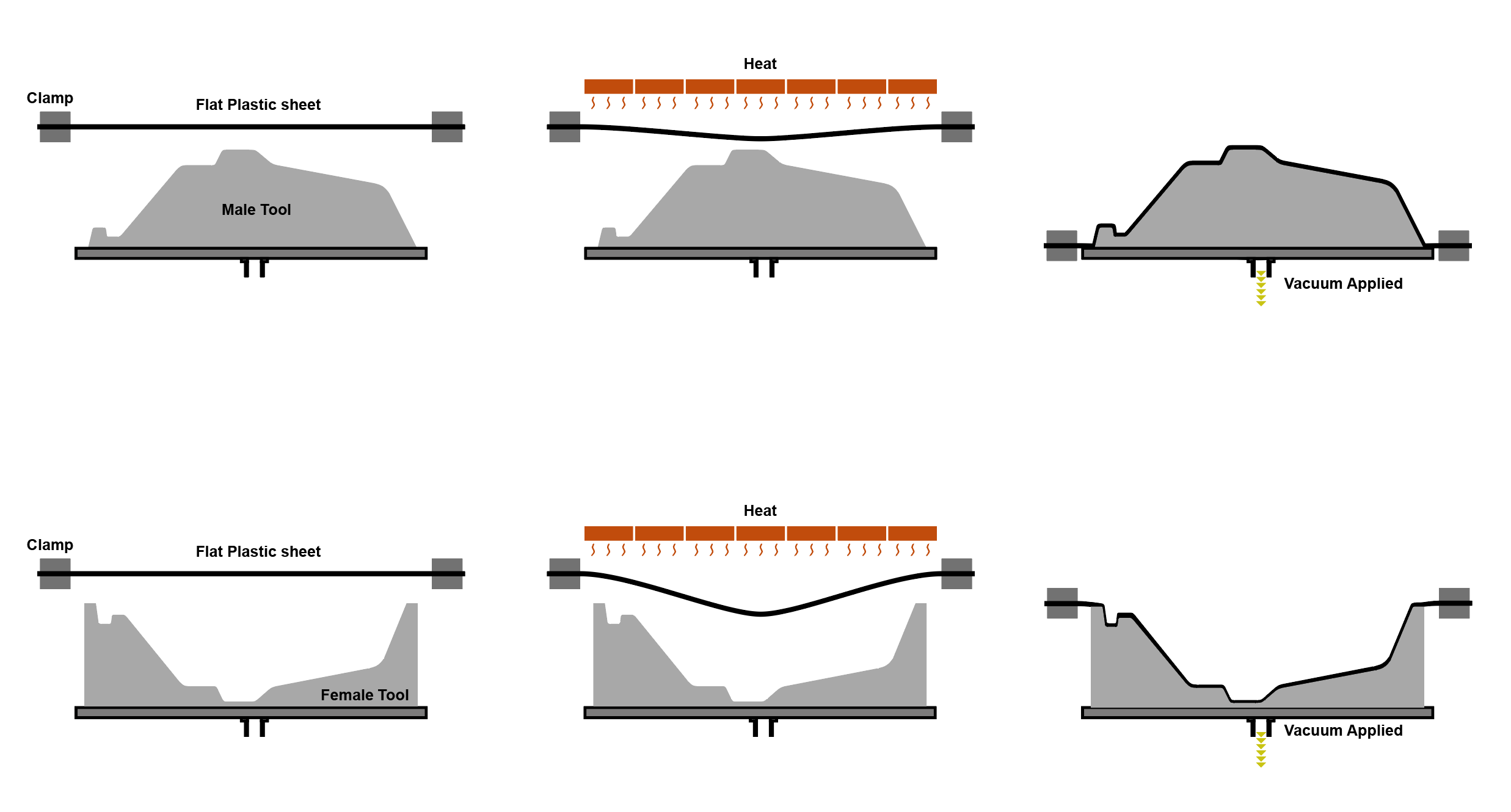
The vacuum forming process works by heating extruded plastic sheets until they become pliable and moldable. Once the material reaches the correct temperature, vacuum suction is applied beneath the mold while atmospheric pressure pushes the heated plastic down to conform to the mold's surface contours.
Temperature control is crucial for successful forming. Too much heat causes excessive stretching and uneven wall thickness, while insufficient heat results in incomplete forming. The vacuum level must be strong enough to pull the material into detailed areas but not so aggressive that it causes tearing.
Key Process Parameters
| Parameter | Typical Range | Critical Factors |
|---|---|---|
| Heating Temperature | Material Specific | Sheet thickness, material type6 |
| Vacuum Level | 85-95% | Mold complexity |
| Cycle Time | 30-180 seconds | Part size, wall thickness |
The process is relatively simple compared to injection molding, making it ideal for prototypes, short runs, and large parts where tooling costs need to be minimized.
How Does Material Flow Impact Your Design Success?
Poor material flow2 understanding causes webbing defects7 that ruin part aesthetics and structural integrity. Designers often overlook this critical aspect during initial design phases.
Material flow follows draping principles - imagine covering your part with cloth. Sharp corners create pleats and webbing, while generous radii enable smooth material distribution and prevent defects during forming.
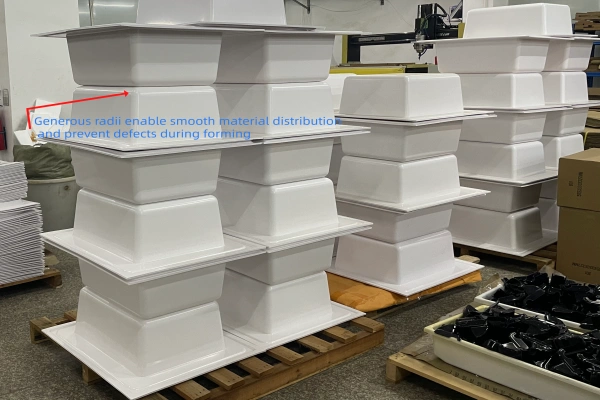
The cigarette packet test provides excellent insight into flow patterns. Take a sheet of paper and attempt forcing it over a cigarette packet - observe how corners create inevitable pleating. This same phenomenon occurs during thermoforming, making corner radii absolutely critical for success.
Material tends to take the path of least resistance during forming. Designers must predict these flow paths and adjust geometry accordingly, ensuring all areas receive adequate material coverage while avoiding stress concentrations that could lead to tearing.
Webbing Prevention Strategies
Key flow optimization principles:
- Minimum corner radii: 3mm for most applications, 6mm preferred for complex shapes
- Gradual transitions: Avoid sudden depth or angle changes
- Flow direction: Design features should work with natural material movement patterns
Sharp corners are the primary enemy of smooth material flow. Even slight radius improvements dramatically enhance formability and reduce the likelihood of webbing defects that require costly rework.
What Draft Angles Prevent Ejection Problems?
Insufficient draft angles5 trap parts in molds, causing damage during ejection. This fundamental requirement gets overlooked in initial designs, leading to production delays.
Male molds require minimum 3° draft, while female molds need 1° minimum. Plastic shrinks onto male tools but away from female tools during cooling, explaining the different requirements.
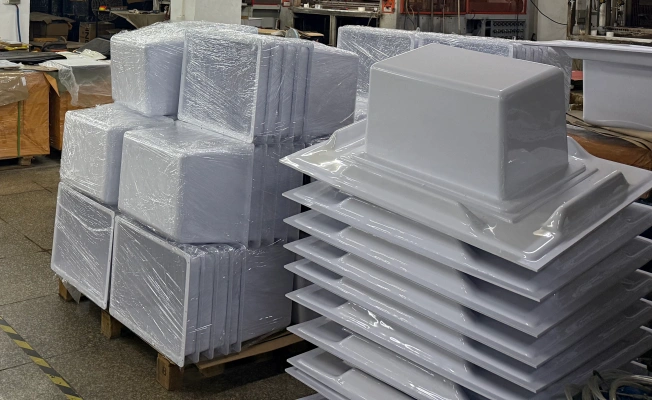
Male molds present greater challenges because cooling plastic shrinks inward, creating tight grips around protruding features. Female molds benefit from plastic shrinking away from cavity walls, naturally reducing ejection forces.
Draft Angle Guidelines
Recommended draft angle standards:
- Male tools: 3° minimum, 5° preferred for complex geometries
- Female tools: 1° minimum, 3° preferred for deep cavities
- Textured surfaces: Add 2-3° extra draft to prevent surface scraping
Temperature control also affects ejection performance. Proper mold temperature can reduce material adhesion to mold surfaces, improving release characteristics.
How Do Draw Ratios Determine Material Thickness Requirements?
Incorrect draw ratio calculations result in thin spots that fail during use. Many designers underestimate material stretching8 effects, leading to parts that don't meet strength requirements.
Draw ratio equals total surface area divided by footprint area. Higher ratios require thicker starting materials to maintain final wall thickness specifications after stretching occurs during forming.
The calculation seems simple: Total Surface Area ÷ Footprint Area = Draw Ratio. However, practical application requires considering that material stretching isn't uniform across the part. Areas with greater depth experience more severe stretching than shallow regions.
Thickness Distribution Prediction
Example calculation:
- Part total surface area: 200cm²
- Footprint area: 100cm²
- Draw ratio: 200 ÷ 100 = 2.0
- Target final thickness: 3mm
- Required starting thickness: 3mm × 2.0 = 6mm
This calculation provides average thickness requirements, but actual thicknesses vary considerably. Deep-drawn areas might retain only 30-40% of original thickness, while flat areas maintain 80-90% of starting thickness.
For critical load-bearing areas, designers must ensure adequate thickness even under maximum stretching conditions.
What Texture Options Enhance Your Product Appeal?
Limited texture understanding restricts design possibilities and increases costs unnecessarily. Proper texture selection improves aesthetics while managing budget constraints effectively.
Vacuum forming offers two main texturing methods: pre-textured materials over male tools (economical but limited options) or custom textures machined into female molds (higher cost but unlimited design freedom).
Pre-textured materials provide the most economical texturing solution, including leather grains, wood grains, and geometric patterns. Custom texture creation requires machining patterns directly into mold surfaces but offers complete design freedom at higher cost.
Texture Design Considerations
Texture selection guidelines:
- Depth control: Texture depth typically limited to 0.5mm maximum
- Directional considerations: Texture orientation affects ejection performance
- Pattern density: Overly dense textures may interfere with material flow2
Why Are Controlled Surfaces Critical for Assembly?
Ignoring controlled surface principles creates assembly problems9 and increases manufacturing costs. This concept determines which surfaces maintain dimensional accuracy throughout the process.
The tool-side surface remains dimensionally controlled while the opposite surface varies with material thickness. Parts requiring precise fit must mate using controlled surfaces exclusively for proper assembly.
Controlled surfaces contact the mold directly, maintaining precise dimensional relationships. The opposite surface varies based on material thickness variations and stretching effects. Understanding this distinction prevents assembly problems9 and enables efficient trimming operations.
Assembly Design Guidelines
Controlled surface applications:
- Assembly interfaces: All critical mating surfaces should be tool-controlled
- Trimming references: Use controlled surfaces for fixture location during cutting
- Tolerance chains: Minimize non-controlled surfaces10 in critical dimension chains
What Essential Toolmaking Guidelines Ensure Success?
Poor toolmaker communication leads to expensive mistakes and project delays. Clear specifications and proper collaboration prevent misunderstandings that compromise quality.
Tools require proper draft, adequate venting, sufficient strength, and appropriate surface finishes11. Vacuum forces can reach nearly 1 tonne over 30cm × 30cm areas, demanding robust tool construction.
Venting represents one of the most critical tool features. Inadequate venting creates air traps that prevent complete forming and may cause visible defects on finished parts.
Critical Tool Specifications
Essential venting guidelines12:
- Vent spacing: 25-50mm between centers for general areas
- Vent size: 0.75mm diameter for standard applications
- Deep areas: Tall features need venting at the top for proper air evacuation
Tool mounting requires adequate fastener strength to resist ejection forces. Aluminum tools need minimum 6mm threaded fasteners, while composite tools require 8mm threads minimum.
Conclusion
Successful vacuum forming demands understanding material behavior, geometric principles, and manufacturing requirements that work together seamlessly for consistent quality results.
Identifying the causes of costly remakes can help you avoid them and save on project budgets. ↩
Understanding material flow is crucial for avoiding defects and ensuring quality in vacuum forming projects. ↩
Learn how draw ratios impact material thickness to prevent failures in your vacuum formed parts. ↩
Learn the essential tool design principles to ensure successful vacuum forming outcomes. ↩
Proper draft angles are essential for easy ejection and preventing damage to your vacuum formed parts. ↩
Different materials have unique properties; understanding them is key to successful vacuum forming. ↩
Discover strategies to prevent webbing defects that can ruin the aesthetics and integrity of your parts. ↩
Understanding material stretching helps in designing parts that meet strength requirements. ↩
Identifying potential assembly problems early can save time and costs; learn what to watch for. ↩
Understanding controlled surfaces is key to ensuring precise assembly and reducing manufacturing costs. ↩
Choosing the right surface finish can enhance the quality and appearance of your vacuum formed products. ↩
Proper venting is critical for successful vacuum forming; learn the guidelines to avoid air traps. ↩